Wants to Earn High Rates of Return with their Investment Capital or IRA Safely & Securely
What is private lending?
Q: What does it mean to become one of my Private Lenders?
A: When I desire to borrow money by offering the property as collateral, I give my Private Lender an opportunity to make the loan… and earn high-interest rates that are up to 14 times as much as the rates you can get on bank CDs or other traditional resources.
How is the money used?
Q: How will I be using your money?.
A: As a professional real estate investor I need to fund new purchases, sometimes do renovations and fix up properties… plus cover the other costs associated with buying and selling houses.
For properties we already own and manage, there are times when we want to convert some of our equity into cash -- without selling the property. This cash may be used to fund our house-buying business, pay off other real estate notes that come due, and handle other cash needs.
Why Not Banks?
Q: Why don’t you go to banks or mortgage lenders?
A: Banks and other lenders require applications, and approvals and must follow guidelines imposed
by the banking industry. Plus, there are limits to the number of loans they can make to any one company or investor. On top of that, the time it takes for their approval process is never certain. I can move much faster without these limitations by using Private Lenders. That allows me to negotiate more profitable deals while offering homeowners a quick and easy sale without a new loan or deal-breaking contingencies.
Q: How can I afford to pay such high rates?
A: I make my money by providing valuable services to sellers, buyers, renters, and Private Lenders. By cutting out the middlemen, I can avoid the costs normally paid out for real estate commissions, mortgage broker fees, loan fees, and property management fees. I calculate my offers on properties so that buyers and sellers get a great deal. At the same time, a minimum profit of $30,000 to $50,000 is earned between the time of purchase and sale..
Help for sellers and buyers
Q: How do I help sellers?
A: A lot of sellers today are having trouble finding a buyer. And there are typically a lot of hassles sellers must endure getting their home sold. Using a long-term investing approach, I can offer sellers an attractive price, close or take possession whenever they want… and give them an opportunity to avoid all the hassles of selling a house.
Q: How do I help buyers?
A: I offer several great programs and unique opportunities for buyers. This includes an owner financing program, a down payment assistance program, and a sweat equity program. Buyers today are finding it more and more difficult to qualify for loans. These programs help buyers get into a home they want to purchase quickly… allowing them to start building equity for the future ...
Rate and term
Q: What interest rate do you pay?
A: That depends on the deal at hand, what works for you, and what works for me. It will be much higher than any CD or traditional investment. It also depends on the current market rates.
Q: How long will my investment funds be tied up?
A: Most of my private loans are set up on a 12 to 18-month or 3 to a 5-year term. However, it depends on what the Private Lender wants and needs… and what the property deal. So, depending on our plan for the property, we might be able to offer you a shorter term… or we may ask if you’re willing to commit to a longer-term plan. Regardless, you’ll always decide what term works best for you.
Q: What if I commit to a longer-term and then need my money sooner?
A: My policy is to pay off (or replace) any Private Lender who requests an early payoff whenever possible. Sometimes a partial early payoff meets the lender’s needs, allowing the rest of their money to continue to earn high rates. I ask you to give me advance notice, preferably 90 days, so we can do whatever we can to meet your request. I would attempt to meet such a request by refinancing the property, selling the property, or most likely, having another one of my Private Lenders take over your position. There will be a 5% fee of the outstanding principal.
Q: Will I earn interest for the entire term of the note?
A: Your interest is fixed and locked in for as long as the note is out. However, I may sell or refinance the property before the full term is up. You’ll always earn your note interest until it’s paid in full. But I do have the right to pay off the note early.
Q: What if you pay me off only a month after I invest?
A: I understand you might be liquidating investments or foregoing another investment program to get a high rate of return. Therefore, I agree in writing, you’ll receive a minimum of 6 months of interest. So, if I need to pay you off sooner than expected, I
would either move your mortgage to another property by substituting the collateral or pay you off in full including a minimum of 6 months of interest earned.
Q: Will I receive monthly payments?
A: Most of my Private Lenders prefer letting the interest accrue and getting a big check when the property cashes out. A few Private Lenders prefer payments. These lenders are usually retired and have cash flow needs.
Minimum Investment
Q: What is My minimum investment?
A: My “First Position Private Lenders” would usually need a minimum available to invest of $100,000 for most deals. However, there are some deals that come along now and then where a lower amount could be accepted. My “Second Position
Private Lenders” would usually need a minimum of $30,000.
Guarantee?
Q: Is your investment program insured by the government?
A: No. There is no government back.
guarantee on these real estate notes. However, your protection and security is the amount of equity in the property that secures the note. I will not allow my Private Lenders to loan more than 70% of the value of the property securing the note. That way, the Private Lenders always have at least a 30% “Equity Cushion” in the property.
IRS Approved for Retirement Accounts?
Q: Has the IRS approved using retirement accounts?
A: YES! The IRS does establish guidelines that must be followed in order for a Retirement Account (IRA) to invest in real estate notes tax-deferred or tax-free. You’ll need the services of a company approved by the IRS to act as your custodian to invest your retirement funds. I have been very pleased with Quest IRA, Inc. I’ll be glad to answer questions about Quest IRA, Inc. and can provide brochures and information from Quest IRA, Inc.
Loan to value?
Q: How do I know if there’s enough value or equity in the property to sufficiently protect my investment?
A: It’s my policy not to borrow more than 70% of the value of a property using Private Lender money. That leaves at least a 30% cushion of equity. You will receive full details on the value, status, and condition of the property whenever I present you with an opportunity to lend
Cost and Insurance
Q: Do you provide title insurance?
A: Absolutely! I never buy a property without title insurance. However, if I am refinancing a
property there would be no need for a new title policy.
Q: Are there any Up-Front Costs?
A: I pay for all closing costs, so your entire investment goes to work for you. I will pay for the closing real estate attorney, document prep fees, notary fees, overnight mail fees, bank wire fees, and
recording costs. There are no charges or fees whatsoever incurred by you.
Q: What happens if the property burns down?
A: A valid hazard insurance policy is always in place to protect against causalities. You’ll be named as a mortgagee. Insurance distributions would be used to rebuild or repair the property or used to pay you off.
Loan Positions
Q: Will my money be pooled with other investors?
A: No. Your funds will fund one real estate note secured by a Deed of Trust on a property with sufficient equity as protection.
Q: What is a junior lien or second mortgage?
A: It’s a loan secured by real estate that is positioned behind a senior mortgage or first mortgage.
Documents and Paperwork
Q: What kinds of documents and paperwork will I receive?
A: Your closing package should include: Original Promissory Note, a Copy of the Deed of
Trust or Mortgage, Copy of Property Insurance
Binder naming you as the mortgagee, and a Title Insurance Policy insuring you against any title problems, Appraisal of the property.
Jacksonville Housing Market: Trends and Forecast 2024-2025
November 13, 2024 by Marco Santarelli
Add Subtext text. Click "Edit Text" to update the font, size and more.
To change and reuse text themes, go to Site Styles.
Are you thinking about buying or selling a home in Jacksonville in 2024? The Jacksonville housing market is showing signs of a shift after a period of intense growth.
market is becoming less competitive for buyers.
It appears that the days of frenzied bidding wars and homes selling way above asking price are starting to fade, offering a more balanced opportunity for both buyers and sellers. Let's dive deeper into the current Jacksonville housing market trends to help you understand what's happening and what you can expect in the coming months.
Jacksonville Housing Market Trends in 2024
Home Sales
Based on data from Redfin, the number of homes sold in Jacksonville in September 2024 has decreased slightly compared to the same period last year. Specifically, there were 1,000 homes sold in September 2024, down from 1,095 in September 2023. This represents a -8.7% decrease year-over-year. While this dip isn't dramatic, it indicates a cooling of the previously very hot market.
I think that this cooling trend is a natural response to several factors. Interest rates have risen, making mortgages more expensive, and potential buyers are becoming more cautious about making large financial commitments. Also, sellers who held on to inflated expectations for their home sale prices are finally being forced to realize that they may not get the premium they were hoping for. It's an interesting shift in the market.
Home Prices
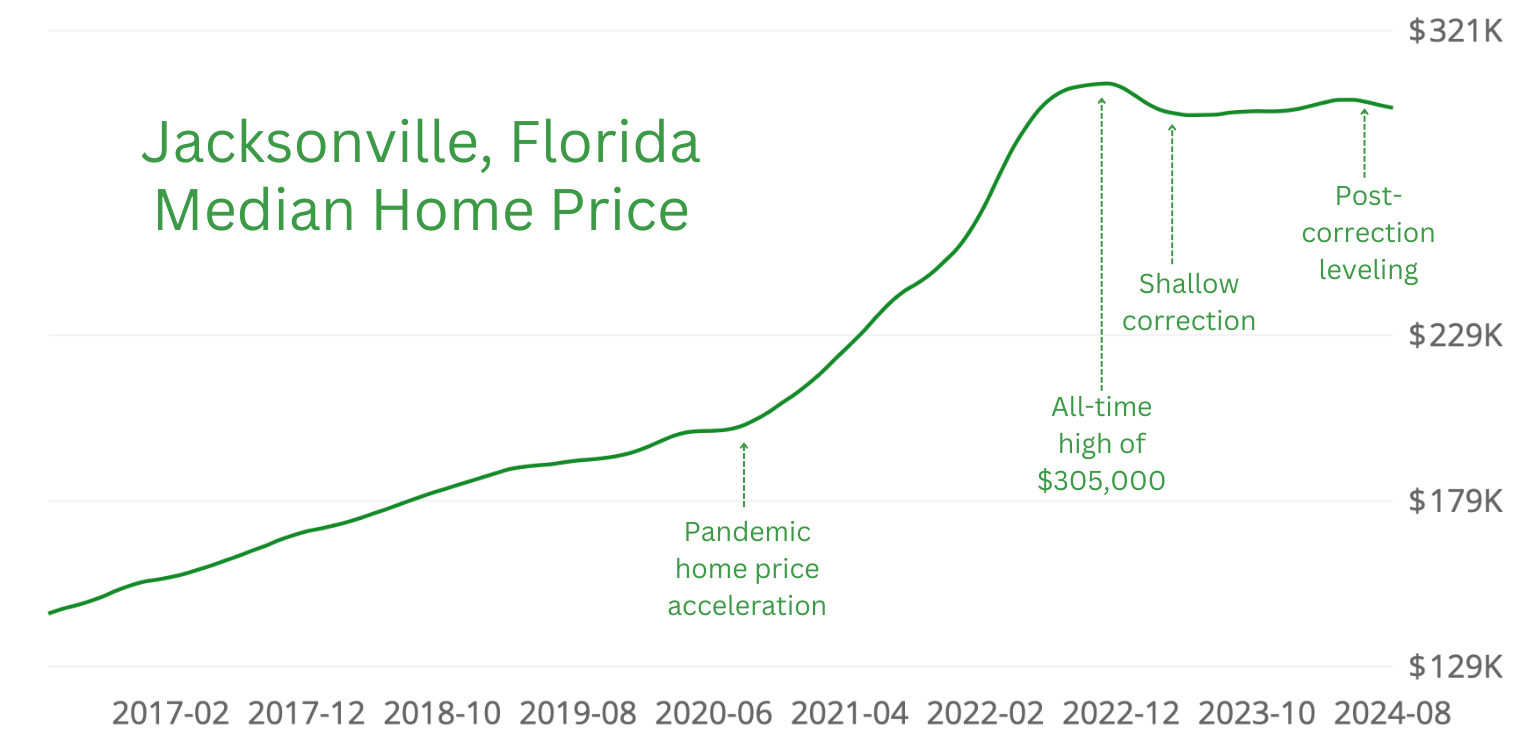
Despite the slowing in sales, median home prices in Jacksonville are still up compared to last year. In September 2024, the median sale price was $310,000, representing a 3.3% increase year-over-year. This rise in home prices is consistent with the broader national trend of inflation affecting the cost of building materials and labor, which ultimately trickles down to home prices.
However, it's important to note that the pace of price increases has slowed significantly compared to previous years when home prices were soaring at much higher rates. While home values have not started dropping yet, it's clear that the market is adjusting.
Housing Supply
The number of homes available for sale in Jacksonville is also an important factor influencing the market. While I don't have specific data on the exact inventory levels, I know that Redfin data suggests that homes in Jacksonville are taking longer to sell than before. The **median days on market is now 60 days, a considerable increase from the 38 days last year. This lengthening of the sales cycle suggests that there is slightly more inventory on the market, giving buyers more time to compare properties and negotiate offers.
Market Trends
The Jacksonville housing market is currently in a state of transition. It's moving from a seller's market to a more balanced market, where buyers have slightly more leverage in negotiations. As we move through 2024 and into 2025, it will be interesting to see if the market continues to shift in favor of buyers or if it settles into a more stable equilibrium.
Here's a summary of some of the key market trends we've discussed:
Cooling Sales: The pace of home sales is slowing down.
Moderate Price Growth: Home prices are still up year-over-year, but the rate of increase has slowed down significantly.
Increasing Days on Market: Homes are taking longer to sell.
Shifting Balance: The market is shifting from a seller's market towards a more balanced market.
Is It a Buyer's or Seller's Housing Market?
As I mentioned previously, the Jacksonville housing market is transitioning from a seller's market to a more balanced market. While sellers still have the upper hand in certain niche areas or for highly desirable homes, buyers now have more options and a better chance of negotiating favorable terms.
In my experience, this means that buyers are no longer under intense pressure to make quick offers or waive contingencies. They can take their time, carefully consider their options, and potentially negotiate a lower price.
Are Home Prices Dropping?
While there is evidence of a slowing in home price appreciation, at the moment, I haven't seen widespread significant drops in Jacksonville. The market is adjusting to the new realities of higher interest rates and a slightly increased inventory.
It's important to consider that a drop in home prices is not necessarily a bad thing. In fact, a more moderate and sustainable market is generally healthier for the long-term stability of the community. However, it's crucial to monitor the market closely and stay informed about the current trends in your area of interest.
I always tell folks that it's a good idea to connect with a local real estate agent who can provide you with more specific insights into the neighborhoods and price points that you're looking at. They can give you a more detailed idea of what's happening in the local micro-markets that you're interested in.
Factors Influencing the Jacksonville Housing Market
Several factors are currently impacting the Jacksonville housing market.
Interest Rates: The Federal Reserve has been raising interest rates to combat inflation, which has made mortgages more expensive. This has slowed the demand for homes, particularly from buyers who are sensitive to rising borrowing costs.
Inflation: The overall economy is still experiencing inflationary pressures, affecting the cost of building materials, labor, and goods and services. This can impact both home prices and the affordability of buying a home.
Population Growth: Jacksonville's population is continuing to grow, which puts upward pressure on housing demand. The influx of new residents keeps a certain level of competition in the market, especially in desirable areas.
Economic Conditions: The broader economy can impact the Jacksonville housing market. If the economy slows down, unemployment rises, or businesses start to cut back, it could lead to reduced demand for homes.
Local Job Market: Jacksonville's job market is generally healthy, with many industries showing consistent growth. This can support demand for housing in the area and make it more attractive to those looking to relocate.
Inventory Levels: While the supply of homes for sale has increased slightly, it's not a flood of inventory. That may change in the months ahead.
New Construction: The development of new housing projects in Jacksonville is an important factor to keep in mind. Depending on the type and location of these projects, it could impact existing home values and the overall market.
Jacksonville Housing Market Forecast 2024-2025
Predicting Future Trends
It's impossible to predict the future with certainty. Still, based on the current trends, I believe that the Jacksonville housing market will likely continue to moderate throughout 2024 and into 2025. While a crash isn't anticipated, it's likely that home values will dip slightly in the coming quarters. Let's dive deeper into the specifics of the forecast.
What Does the Data Say About Jacksonville Housing Prices in the Next Year?
I’ve been looking at data from credible sources to develop a clearer picture of the Jacksonville housing market forecast. The information is based on forecasts from Zillow. Keep in mind that forecasts are always subject to change, but it is helpful to understand the trends we are seeing.
Here's a snapshot of the anticipated changes:
Period-Expected Annual Change in Home Prices
October 2024-0.3%
December 2024-1.3%
September 2025-0.1%
Based on this data, you can expect home values in Jacksonville to decrease by about 0.3% by October 2024 and fall by as much as 1.3% by the end of 2024. However, the forecast for the end of September 2025 indicates a slight uptick of 0.1%.
Looking Ahead to 2026 and Beyond
It's too early to give a definitive forecast for 2026 regarding Jacksonville housing prices. However, I would expect a more balanced market, with moderate price increases and potential opportunities for buyers. Factors such as the broader economic conditions, interest rates, and the local job market will ultimately play a role in determining future trends.
My Personal Insights on the Jacksonville Housing Market
In my opinion, the Jacksonville housing market is likely to experience a period of stabilization, with a slight cooling of home price appreciation. The current market has seen an increase in available homes, giving buyers more options. This increased inventory has moderated the rapid price appreciation of recent years. Plus, interest rates have also played a significant role in the current environment. We've seen mortgage rates fluctuate, affecting buyer demand.
Here are some of my expectations:
Gradual Price Stabilization: I anticipate that home price growth will continue to slow down and potentially even stabilize or experience a slight dip in certain segments of the market.
Balanced Market Conditions: I expect the market to transition further towards a more balanced state, with neither buyers nor sellers having an overwhelming advantage.
Increased Negotiation Opportunities: Buyers will likely have more room to negotiate prices and terms, especially when compared to the intense seller's market of recent years.
Impact of Interest Rates: The direction of interest rates will significantly impact the housing market. If interest rates begin to fall, it could reignite demand, but if they remain high or increase further, the market could experience a more sustained cooling.
In Conclusion
The Jacksonville housing market is in a period of adjustment and transition. After several years of strong growth, the market is cooling down, with sales slowing and price growth moderating. The market is becoming more balanced, giving buyers more opportunities to negotiate favorable terms.